


close
Choose Your Site
Global
Social Media
Views: 222 Author: Amanda Publish Time: 2026-02-06 Origin: Site


Content Menu
● What Is Cardboard Thickness and Why It Matters
● How Cardboard Thickness Is Measured (GSM, PT, Flutes, Board Style)
>> GSM (Grams Per Square Meter)
>> Table: GSM ranges and typical uses
>> Corrugated Flute Types (A, B, C, E, F)
>> Corrugated Board Styles (Single, Double, Triple Wall)
● How to Choose the Best Cardboard Thickness for Your Products
>> Step 1 – Analyse Your Product and Risk Profile
>> Step 2 – Map Packaging to Shipping and Handling Conditions
>> Step 3 – Balance Cost, Weight, and Protection
>> Step 4 – Align Thickness with Branding and Print Quality
>> Step 5 – Test, Iterate, and Work With a Packaging Expert
● Practical Thickness Recommendations by Industry
● Case‑Style Scenarios – How Thickness Choices Change Outcomes
● GSM vs PT vs Flute – Which Should You Focus On
● Strong CTA – Partner With HLun Pack for Engineered Cardboard Thickness
● FAQ – Cardboard Thickness and Packaging
>> 1. What is a good GSM for packaging boxes
>> 2. What is the standard thickness of corrugated cardboard
>> 3. Which flute type should I choose for e‑commerce packaging
>> 4. Is thicker always better for packaging
>> 5. How do I know if my current box thickness is sufficient
Choosing the right cardboard thickness is one of the most important decisions you can make for product protection, shipping efficiency, and brand perception. When you approach it strategically—using clear metrics like GSM, PT, flute types, and board styles—you reduce damage, control freight costs, and deliver a premium unboxing experience that strengthens your brand.

Cardboard thickness refers to how thick and dense the packaging material is, usually described by GSM, PT, flute type, and wall structure. It directly affects strength, cushioning, print quality, weight, and sustainability.
Key reasons thickness matters:
- Product protection: Thicker or better‑engineered boards provide more cushioning and stacking strength, preventing crushing and impact damage in transit.
- Shipping cost control: Extra‑thick material adds weight and volume; smart selection gives enough protection without over‑engineering the box.
- Brand image and unboxing: Premium surfaces and rigid structures feel higher‑end and support sharper printing for logos and designs.
- Sustainability: Well‑matched thickness means fewer breakages, fewer returns, and less total material used over the product lifecycle.
GSM measures the weight of paper or board per square meter and is a widely used indicator of density and robustness. Higher GSM usually means heavier, thicker, and more durable material.
Typical GSM ranges in packaging:
- 100–150 GSM: Lightweight wrapping, tissue, and simple paper bags.
- 150–220 GSM: Brochures, flyers, wrappers, and medium‑weight retail inserts.
- 210–300 GSM: Brochure covers, sleeves, and lighter folding cartons.
- 350–400 GSM: Standard product boxes and premium folding cartons.
- 400+ GSM: Heavy‑duty paperboard or liners used with corrugated structures.
For most branded product boxes, 250–400 GSM is a practical range depending on product weight and desired rigidity.
GSM Range Typical Use Case Notes
100–150 Tissue, wrapping, paper bags Light, low tear resistance
150–220 Flyers, medium wrappers Balance of flexibility and strength
210–300 Covers, sleeves, light cartons Good for display packaging
350–400 Standard cartons, retail boxes Stronger, more rigid
400+ Liners, heavy boards Often used with corrugated flutes
The point system (PT) measures paperboard thickness in thousandths of an inch, where 1 pt = 0.001 inch. It is common in regions and industries where exact caliper is critical.
Typical PT ranges for packaging:
- 8–10 pt: Thin covers and lightweight cartons.
- 14–16 pt: Standard product boxes and folding cartons.
- 18–24 pt: Premium, rigid cartons and gift boxes.
- 24+ pt: Very rigid boards and specialty packaging.
The same GSM can have different PT values depending on paper type and finishing, so GSM and PT should be considered together. For critical applications, you should evaluate both weight and thickness, not just one indicator.
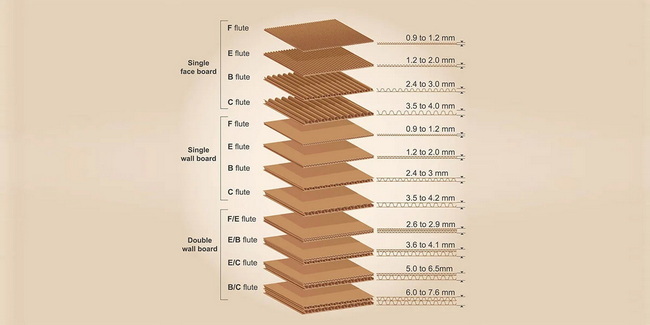
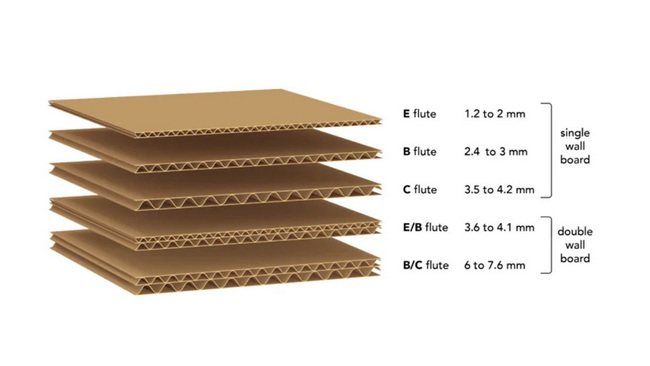
In corrugated cardboard, the flute is the wavy medium between flat liners that creates cushioning and stacking strength. Different flute profiles provide different thicknesses and performance.
Common flute types and approximate thickness:
- A Flute (about 4.7–5 mm): Excellent cushioning, used for fragile or heavy products and long‑distance shipping.
- B Flute (about 3 mm): Good compression resistance and puncture resistance, often used for standard shipping cartons and inner partitions.
- C Flute (about 3.2–4 mm): The most common general‑purpose shipping flute, balancing strength and printability.
- E Flute (about 1.5 mm): Thin and lightweight with a smooth surface, ideal for retail boxes, mailers, and high‑quality printing.
- F Flute (about 0.8–1 mm): Ultra‑thin, used for small premium packaging like cosmetics and electronics where fine graphics matter.
Board style describes how many fluted layers and liners are combined. Thickness and strength increase with each additional wall.
- Single Wall (about 2–7 mm): One fluted layer between two liners; standard for most everyday shipping boxes.
- Double Wall (about 5–12 mm): Two flutes and three liners; used for heavy, bulky, or moderately fragile goods.
- Triple Wall (about 10–15+ mm): Three flutes and four liners; suitable for industrial, palletized, or export packaging requiring maximum stacking strength.
Combining flute type and wall style is the real key to performance. For example, a double‑wall BC flute is much stronger than single‑wall C flute alone, even if the nominal outer dimensions look similar.
Start from the product itself:
- Weight: Heavier items need stronger flutes, such as C or BC double wall, and higher GSM liners.
- Fragility: Glass, ceramics, electronics, and artwork require better cushioning, such as A or C flute, inserts, or foam.
- Shape and sharp edges: Irregular or sharp products need better puncture resistance, such as B or BC flute.
A simple rule is that the more fragile and valuable the product, the more you should invest in thickness and structural design, not just surface GSM.
Consider where and how your packaging will travel:
- Local, short‑distance courier: Single‑wall C or B flute is often enough for non‑fragile items.
- National or cross‑border shipping: Stronger flutes or double wall help withstand stacking and repeated handling.
- E‑commerce parcel networks: Corrugated with good edge crush strength plus inserts or dividers works best for multi‑item orders.
If products are shipped on pallets with high stacking, board strength and flute combination are more critical than just nominal thickness.
Over‑thick board increases both material cost and shipping charges. Under‑specified board increases damage, returns, and negative reviews. The goal is optimized protection:
- Use thinner, high‑performance board (for example, E flute with strong liners) for lighter items and branded retail mailers.
- Reserve double‑wall boards or higher GSM liners for products whose weight or fragility truly justifies the upgrade.
- For printed retail boxes, prioritize printable surfaces and structural design, not just raw thickness.
By balancing these factors, you can achieve a stable total cost while maintaining customer satisfaction.
Thicker, smoother boards make your branding look more premium:
- E and F flutes with higher‑GSM liners deliver a smooth, flat surface for high‑definition printing.
- Higher‑GSM folding carton boards (for example, 350–400 GSM) are ideal for cosmetics, electronics accessories, and premium retail items.
- Laminations, coatings, and special finishes work best on dimensionally stable boards with consistent thickness.
This is where HLun Pack can combine material selection, structural design, and printing to create a cohesive and consistent brand experience.
Lab tests and real‑world trials are essential:
- Use drop tests, compression tests, and vibration tests to validate thickness and structure for your logistics chain.
- Request sample runs with different flute types and GSM levels to compare print quality and stiffness.
- Partner with a packaging specialist who can translate your product and channel requirements into an engineered board specification.
As a professional packaging materials manufacturer, HLun Pack can provide structural design, sample testing, and on‑site packaging optimization so you are not guessing thickness, you are proving it.
To make selection easier, here are practical starting points for common industries. These should always be validated and fine‑tuned through testing.
Product Type Suggested Board Typical Thickness Why It Works
Cosmetics & skincare 350–400 GSM folding carton or E/F flute micro corrugated About 0.35–2 mm Premium look, good print, adequate for light items
Consumer electronics E or F flute, single or double wall with higher GSM liners About 1.5–4 mm Strong edges, good cushioning for shocks
Food (dry snacks, cereals) 250–350 GSM carton; E flute for e commerce shipping About 0.25–1.5 mm Light, cost effective, good shelf presence
Heavy spare parts C or BC flute double wall About 6–12 mm High stacking and puncture resistance
Artwork & fragile decor A or AC flute, often double wall About 7–12 mm Maximum cushioning and crush resistance
Use this table as a starting framework, then refine the board grade based on your exact product weight, fragility, and logistics conditions.
To deepen understanding, consider these scenario‑style examples.
1. Small cosmetics shipped D2C
- Challenge: High visual expectations, light contents, long courier routes.
- Solution: 350–400 GSM folding carton for the primary box, shipped inside an E‑flute mailer to protect printing and corners.
2. Industrial components going on pallets
- Challenge: Very heavy loads, tall pallet stacks, forklift handling.
- Solution: Double‑wall or triple‑wall board with suitable flutes (such as BC or combinations) plus reinforced corners and inner supports.
3. Artwork or framed prints
- Challenge: Fragile glass, risk of edge crush and impact.
- Solution: A or AC flute with foam or corrugated inserts, edge protectors, and validated drop tests to fine‑tune thickness.
These examples show why there is no single “best” thickness, there is only the best thickness for a specific product and shipping reality.
Many buyers get stuck choosing between GSM, PT, and flute type. In practice, you should treat them as complementary:
- Use GSM to understand paper density and overall board weight.
- Use PT when exact caliper and stiffness are critical, especially for folding cartons.
- Use flute type and wall style to define structural performance for shipping and stacking.
Best practice is to define your needs in terms of product, shipping, and branding. Your packaging partner can then translate those requirements into a combined GSM, PT, and flute specification that is both efficient and reliable.
Choosing cardboard thickness should never feel like guesswork. Your products, shipping routes, and brand goals deserve engineered packaging, not generic boxes. HLun Pack combines professional packaging materials manufacturing with packaging machinery and integrated packaging solutions to design, test, and supply exactly the board thickness and structure your products need.
If you want to reduce damage and returns, stabilize shipping costs, and upgrade your brand image with high‑quality printed packaging that actually fits your logistics, HLun Pack is ready to support you from concept to mass production. Share your product specifications, shipping conditions, and branding requirements, and our team will develop a tailored cardboard thickness and structure, provide samples, and help you integrate it into your packaging process.
Contact HLun Pack today to schedule a dedicated packaging thickness consultation and get a customized, data‑driven solution for your next shipment.
Contact us to get more information!
For most product boxes, 300–400 GSM offers a good balance of stiffness, durability, and print quality. Heavier products or more premium applications may require even higher GSM or a combination of carton board with corrugated structures.
Common shipping boxes use single‑wall board around 3–4 mm thick, typically with B or C flute. Double‑wall options can reach 6–12 mm and are used for heavier or more fragile goods that demand higher stacking strength.
For e‑commerce parcels, C flute is a reliable general‑purpose choice for a wide range of products. E flute works well for smaller items that require better print quality and a more compact, lightweight box, and combinations such as BC flute are often used where extra protection is required.
Thicker board is not always better. While extra thickness can increase protection, it also adds weight and cost, so the real goal is to match thickness to product risk, shipping distance, and handling conditions instead of simply choosing the thickest available option.
You can monitor breakage rates, customer complaints, and shipping damage records to judge whether your packaging is performing well. If you see frequent damage, crushed corners, or returns due to transit issues, it is time to review flute type, GSM, and structural design with a packaging expert.
1. https://www.mtdpack.com/cardboard-thickness-guide/
2. https://www.kimecopak.ca/blogs/news/cardboard-thickness
3. https://www.zdpackagingbox.com/gsm-vs-pt-paperboard-units-whats-the-difference/
4. https://packccp.com/flute-types-in-corrugated-boxes/
5. https://pakfactory.com/blog/gsm-vs-pt-unit-system/
6. https://www.boxgenie.com/blogs/news/cardboard-thickness-guide
7. https://noissue.co/blog/the-ultimate-cardboard-weight-and-thickness-guide/
8. https://oxopackaging.com/blog/how-thick-is-cardboard.html
9. https://tycoonpackaging.com/minimum-box-thickness-for-shipping-art-the-ultimate-guide-for-effective-packaging/
10. https://wertheimerbox.com/corrugated-cardboard-grades-and-thickness/
11. https://gwpg.com/wp/what-you-should-know-about-gsm-vs-pt-in-packaging/
12. https://105packaging.com/blogs/packaging/cardboard-thickness-guide-a-b-c-d-e-flutes/
13. https://arvco.com/articles/understanding-the-different-types-of-corrugated-flutes/


