


close
Choose Your Site
Global
Social Media
Views: 222 Author: Amanda Publish Time: 2026-01-22 Origin: Site


Content Menu
● Why Product Labels Matter for Sales and Compliance
● How Labels Shape Consumer Trust and Perception
● Key Parts of a High-Performing Product Label
>> 2. Product Name and Variant
>> 3. Product Description and Key Benefits
>> 4. Ingredients and Nutritional Facts
>> 5. Net Weight, Volume, and Quantity
>> 6. Manufacturer and Contact Information
>> 7. Certifications, Seals, and Symbols
>> 8. Barcodes, QR Codes, and Variable Data
>> 9. Safety Warnings and Precautions
>> 10. Usage Instructions and Storage Guidance
● Types of Product Labels by Manufacturing Process
● Types of Product Labels by Purpose
● Modern Design Strategies for High-Impact Labels
>> 1. Use Clear, Legible Typography
>> 2. Build a Strong Visual Hierarchy
>> 3. Balance Simplicity and Distinctiveness
>> 4. Design for Sustainability and Eco Messaging
>> 5. Integrate Digital Experiences
● Practical Label Layout Tips for Better UX
● Visual Elements: Color, Imagery, and Finishes
● Step-by-Step Workflow: From Concept to Printed Label
>> Step 1: Define Objectives and Constraints
>> Step 2: Create a Content Blueprint
>> Step 3: Develop Design Concepts
>> Step 4: Review for Compliance and UX
>> Step 5: Pre-Press and Prototyping
● Future Trends in Product Labeling
● How HLun Pack Supports Your Label and Packaging Strategy
● Clear Call to Action: Partner with HLun Pack for Smarter Labels
● Frequently Asked Questions About Product Labels
>> FAQ 1: What is the difference between a product label and packaging?
>> FAQ 2: How do I choose the right label material?
>> FAQ 3: What are the most important elements that must appear on a product label?
>> FAQ 4: How can product labels improve e-commerce performance?
>> FAQ 5: How often should product labels be updated?
As a professional packaging manufacturer and integrated packaging solutions provider, HLun Pack understands that your product label is one of the most powerful tools for winning attention, building trust, and driving sales. A strategic approach to product labels can transform simple packaging into a high-performing branding and conversion asset for both physical shelves and online channels.

A product label is the printed or applied information panel on your packaging that communicates what the product is, who made it, how to use it, and why it can be trusted. It connects your brand to shoppers in seconds by combining visual design, legal information, and persuasive messaging.
Typically, product labels include:
- Brand name and logo
- Product name and a concise description
- Ingredients and nutritional information (where applicable)
- Net weight, volume, and quantity
- Safety warnings and usage instructions
- Certifications and regulatory symbols
- Barcodes, QR codes, and batch or lot numbers
When designed strategically, labels demonstrate your real-world experience, category expertise, and commitment to transparency, all of which strengthen brand credibility.
Well-designed labels do much more than decorate packaging; they directly influence buying decisions and compliance outcomes. In crowded categories, labels often determine which product gets picked up, scanned, or added to cart.
Key roles of effective product labels include:
- Driving purchase decisions by highlighting benefits, differentiators, and credibility cues
- Ensuring legal compliance with sector-specific regulations
- Protecting consumers with clear usage instructions and safety warnings
- Supporting operations with barcodes, batch codes, and traceability data
Modern regulations and retailer standards increasingly emphasize clear typography, sufficient contrast, and readable font sizes, making these factors essential components of label strategy.
Trust and transparency are now core purchasing drivers, particularly in food, personal care, and household categories. Shoppers routinely check labels for ingredients, claims, and certifications before deciding to buy.
Label elements that build trust include:
- Verifiable claims, such as “organic,” “recyclable,” or “fragrance-free”
- Consistent branding across all SKUs in a product line
- Clear, straightforward language that avoids exaggerated promises
Misleading or vague labels can lead to reputational damage, regulatory action, and even product recalls, so a fact-based, well-documented label strategy is crucial.
Most packages use at least two key label zones: a prime label and a secondary label. Understanding their roles helps you organize content for maximum impact.
1- Prime label (front)
- Focuses on brand name, logo, product name, key benefit, and hero imagery
- Aims to grab attention and communicate core value in a few seconds
2- Secondary label (back or side)
- Focuses on ingredients, detailed usage instructions, warnings, certifications, and codes
- Aims to answer detailed questions and remove doubts before purchase
The prime label “wins the glance,” while the secondary label “secures the decision” by providing all the information a cautious buyer might look for.
Breaking your label into intentional components makes design and compliance more systematic. Below are the most important parts and why each matters.
The brand name and logo are usually the most prominent elements on the prime label. They help shoppers recognize your product instantly and differentiate it from competitors on the shelf.
A strong, consistent presentation of your branding supports recall, loyalty, and cross-selling across related product lines.
The product name clarifies what the product is, while the variant identifies the flavor, scent, shade, or other differentiator. Together, they need to be instantly legible both in-store and on mobile screens.
Clear naming, combined with short descriptors, makes it easier for customers to compare SKUs and quickly find the version that best matches their needs.
A concise description summarizes what the product does and who it is for. It often appears as a short sentence or a small group of bullets.
To avoid clutter, highlight no more than three primary benefits, focusing on outcomes that are most relevant to your target audience.
Ingredients and nutritional facts are essential for foods, beverages, supplements, and cosmetics. They support informed decisions, allergy management, and dietary preferences.
Present this information in a structured, familiar format to reduce confusion and help consumers compare products quickly within a category.
Net contents (such as grams, milliliters, or number of units) indicate exactly how much product the customer receives. This information supports price-per-unit comparisons and prevents misunderstandings.
Many markets specify how and where net contents must appear, especially on the principal display panel, so correct placement is critical.
Manufacturer or distributor information typically includes the company name, address, website, and sometimes customer service contacts. This data supports traceability and signals that the brand is reachable and accountable.
Adding a website and customer support channel also makes it easier for consumers to register complaints, verify authenticity, or seek usage help.
Certifications and seals (for example, organic, fair trade, cruelty-free, or energy rating marks) provide quick visual proof that your product meets recognized standards.
To maintain trust, use only legitimate and relevant certifications and ensure visual clarity, so shoppers can recognize them instantly.
Barcodes enable checkout, inventory management, and logistics, while QR codes can link customers to extended content such as instructions, recipes, videos, or authenticity verification.
Variable data, including batch or lot numbers, manufacturing dates, or serialization, supports recalls, quality tracking, and after-sales service.
Safety warnings are essential for categories like chemicals, electronics, toys, and certain foods or supplements. They may include hazard icons, age restrictions, or usage limits.
Placing these warnings where they are easy to find and read reduces risk and demonstrates your commitment to consumer safety.
Usage instructions and storage guidance help consumers get the best performance and shelf life from your product. For complex products, step-by-step instructions are especially important.
Clear, well-organized instructions also reduce customer support inquiries and the risk of product misuse or disappointment.
Choosing the right label construction affects durability, cost, print quality, and application speed. Below are commonly used label types categorized by their manufacturing process.
Label type | How it works | Best for |
Pressure-sensitive | Self-adhesive label on a liner, applied with pressure to the container. | Food, beverages, cosmetics, and many fast-moving consumer goods |
Shrink sleeve | Printed film that shrinks tightly around the container when heat is applied. | Contoured bottles, 360° branding, tamper-evident applications |
Cut-and-stack | Labels printed on sheets, cut, and glued onto packaging. | High-volume beverages, canned goods, and cost-sensitive products |
In-mold label | Label fused into the container during the molding process. | Durable plastic packaging and premium “no-label-look” designs |
Pressure-sensitive labels offer flexibility for multi-SKU portfolios, while in-mold labels provide long-lasting durability and a seamless visual finish. Selecting the right type depends on your product, container, production line, and budget.
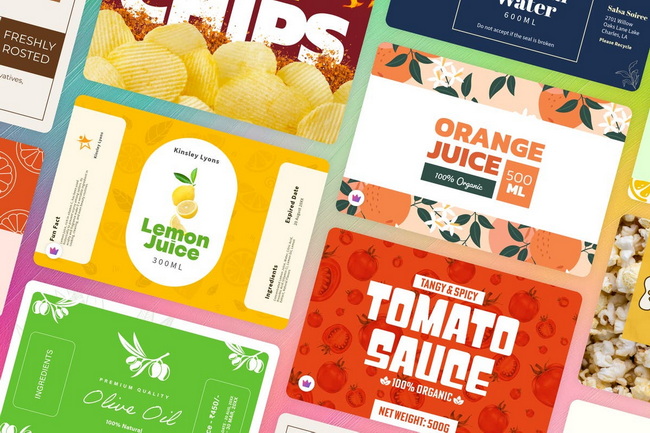
Labels can also be categorized by what they communicate. Designing with purpose in mind helps you prioritize content, layout, and visual emphasis.
1- Brand labels
- Focus on brand identity with logo, brand colors, and core tagline
- Used across SKUs to maintain consistent recognition
2- Descriptive labels
- Provide factual details such as ingredients, usage, storage, and safety information
- Highly regulated in food, pharmaceutical, and cosmetic categories
3- Grade or quality labels
- Indicate quality, performance, or efficiency levels
- Often assigned under standardized criteria by independent bodies
4- Promotional labels
- Highlight offers like “New,” “Limited Edition,” or price discounts
- Create urgency but should not overpower critical information
Many brands also use eco-focused labels to highlight recycled materials, low-impact production, or recyclability, reflecting sustainability commitments and consumer expectations.
Beyond compliance, your label design should actively help your product sell. A robust label design strategy aligns visuals, layout, and messaging with audience expectations and regulatory requirements.
Choose typefaces that remain readable at small sizes, especially on curved surfaces or in low-light environments. Maintain strong contrast between text and background.
Avoid highly decorative fonts for critical information such as ingredients or warnings, and set minimum font sizes that work for both physical shelves and online zoom views.
Establish a clear order of importance: brand and product name first, key benefits second, detailed information last. Font size, weight, spacing, and color can all signal hierarchy.
Group related information into visual blocks with headings, and create consistent patterns so shoppers can quickly locate what matters to them.
Limit your color palette to a few core brand colors and use white space generously to keep layouts clean. Overcrowded labels can make important details harder to find.
Add distinctive visual elements such as illustrations, textures, or patterns to stand out, but keep them controlled so they do not compete with essential information.
Whenever possible, select recyclable, biodegradable, or responsibly sourced label materials and finishes. Make any sustainability attributes clear but honest on the label.
Avoid material combinations that are difficult to recycle, and consider how the label interacts with the rest of the packaging in local recycling streams.
QR codes or NFC tags can turn your label into a gateway to richer content, such as tutorials, recipes, product origin stories, or authenticity checks.
By shifting secondary details online, you preserve on-pack simplicity while providing deep information for customers who want it.
From a user experience perspective, a label should be scannable, self-explanatory, and visually comfortable. Small layout decisions can significantly affect how your product is perceived.
Consider the following UX-focused practices:
1. Group content into clear sections with short headings such as “How to Use,” “Ingredients,” and “Warnings.”
2. Use short paragraphs and bullet lists instead of long blocks of text.
3. Reserve prime visual areas for brand, product name, and one key benefit.
4. Place barcodes and QR codes in unobstructed zones that scanners can easily reach.
5. Ensure that crucial information is not distorted or hidden by curves, caps, seams, or sealing areas.
When space is limited, prioritize legally required and functional content on-pack and move extended storytelling to digital channels via codes.
Visual choices strongly influence shelf standout and perceived product value. Align colors, imagery, and finishes with your brand positioning, whether premium, eco-friendly, clinical, or playful.
Effective tactics include:
- Color choices that reflect category conventions but still differentiate your brand
- Imagery that quickly communicates flavor, use case, or key ingredients
- Print finishes such as embossing, foiling, matte or gloss coatings, and spot UV to convey premium quality
Prime labels are the best place to invest in higher-end finishes, while secondary labels can be kept simpler to manage cost.
Many brands struggle not with label ideas, but with the process of turning those ideas into print-ready, compliant artwork. A structured workflow keeps projects efficient and reduces risk.
Clarify your target audience, positioning, and key messages before any design work begins. At the same time, gather applicable regulatory requirements for your category and target markets.
Consider constraints like container shape, print method, and budget to avoid designs that are beautiful in theory but impractical in production.
List all mandatory items such as legal statements, safety warnings, nutrition facts, and barcodes. Then add optional content such as benefits, storytelling, and sustainability claims.
Prioritize these elements so the design team knows what must stay even if space becomes tight.
Develop initial layouts for both prime and secondary labels, testing color palettes, imagery styles, and typographic systems.
Review these concepts against brand guidelines to ensure consistency across your portfolio, including digital touchpoints like e-commerce listings.
Check that all required information is present, accurate, and placed correctly. Verify claims and certification usage and confirm that the label remains readable in realistic conditions.
Ask internal teams or test users to quickly locate key information, such as allergens or usage directions, to validate the UX of your design.
Produce physical or high-fidelity digital mock-ups to judge color, contrast, and readability on the actual container. This is the moment to confirm fit, alignment, and finishing options.
Run small pilot batches on your labeling equipment to validate performance, adhesion, resistance, and scanning reliability.
Once designs and specifications are approved, work with your packaging and label partners to finalize material, adhesive, and finishing selections.
Define clear quality control standards for color consistency, registration, and barcode or QR scan success, and integrate those checks into your production process.
Labeling is evolving rapidly due to new regulations, sustainability goals, and the growth of digital commerce. Anticipating these trends will help you design labels that stay relevant for longer.
Key trends include:
- Stricter regulatory and retailer demands around clarity of claims, allergen information, and sustainability messaging
- Smart labels that integrate QR, NFC, or RFID for traceability, authenticity, and value-added content
- Increased use of eco-optimized materials, inks, and adhesives that support circular packaging goals
- Labels designed to perform across channels, from physical shelves to e-commerce galleries and augmented reality overlays
Designing with these developments in mind can reduce the frequency of costly redesigns and support long-term brand growth.
As a professional packaging materials manufacturer and provider of packaging machinery and integrated packaging solutions, HLun Pack can support your entire product labeling lifecycle, from concept to high-speed application.
By combining the right materials, machines, and engineering expertise, you can:
- Achieve consistent label placement at high production speeds
- Match label substrates and adhesives to real-world conditions like moisture, temperature, or abrasion
- Integrate barcoding, variable data printing, and automated inspection into your lines
- Balance unit cost with premium visual finishes and durability requirements
Working with a specialist partner ensures that your labels are not only visually compelling but also manufacturable, robust, and aligned with market and regulatory demands.
If you are ready to transform your labels into powerful branding and conversion tools, now is the ideal time to partner with HLun Pack. Our team can help you select the right materials, optimize label design for your machinery, and build an end-to-end packaging solution that supports your growth.
Contact HLun Pack today to discuss your current labels, upcoming launches, or full packaging upgrades, and discover how a smarter labeling strategy can improve shelf impact, compliance, and production efficiency across your entire product portfolio.
Contact us to get more information!
Packaging is the container or wrapping that physically holds and protects the product, while the product label is the printed information applied to that packaging. Packaging focuses on protection, logistics, and shelf life, whereas labels focus on communication and persuasion.
Selecting a label material depends on the container type, product formulation, environmental conditions, and desired look. For example, moisture-resistant films are ideal for chilled products, while paper may be sufficient for dry, ambient goods. Involving your packaging partner early helps align material choice with performance, cost, and brand positioning.
Core elements generally include brand name, product name, net quantity, ingredients or components, manufacturer details, and basic usage instructions. Depending on your category, you may also need nutrition facts, allergen statements, safety warnings, hazard icons, or certifications, all placed in specific ways required by local regulations.
For e-commerce, label design influences how products appear in photos, thumbnails, and zoomed views. Clear typography, simple hierarchies, and benefit-focused front panels help shoppers understand your product quickly in search results and product listing pages, which can increase click-through rates and conversions.
Labels should be reviewed whenever regulations change, formulations are updated, new claims or certifications are introduced, or brand identity evolves. Many companies schedule periodic label audits every few years to stay competitive, correct minor issues, and ensure that on-pack information still aligns with current marketing and compliance requirements.
1. https://pakoro.com/blog/all-about-product-labels-parts-types-design-strategies/
2. https://meyers.com/meyers-blog/all-about-product-labels/
3. https://lowrysolutions.com/blog/understanding-product-labels-types-components-and-design-strategies/
4. https://www.uprinting.com/parts-of-product-label.html
5. https://altrolabels.com/blog/all-about-product-labels/
6. https://www.shopify.com/blog/product-label-design
7. https://pakoro.com/blog/what-is-labeling-in-packaging/
8. https://www.packleaderusa.com/blog/labeler-guide-match-labels-materials-and-design-for-success


